
VENUE: MCA Lecture Theatre, Level 2
This is a free public ‘Long Table’ discussion on radical arts-led models of care.
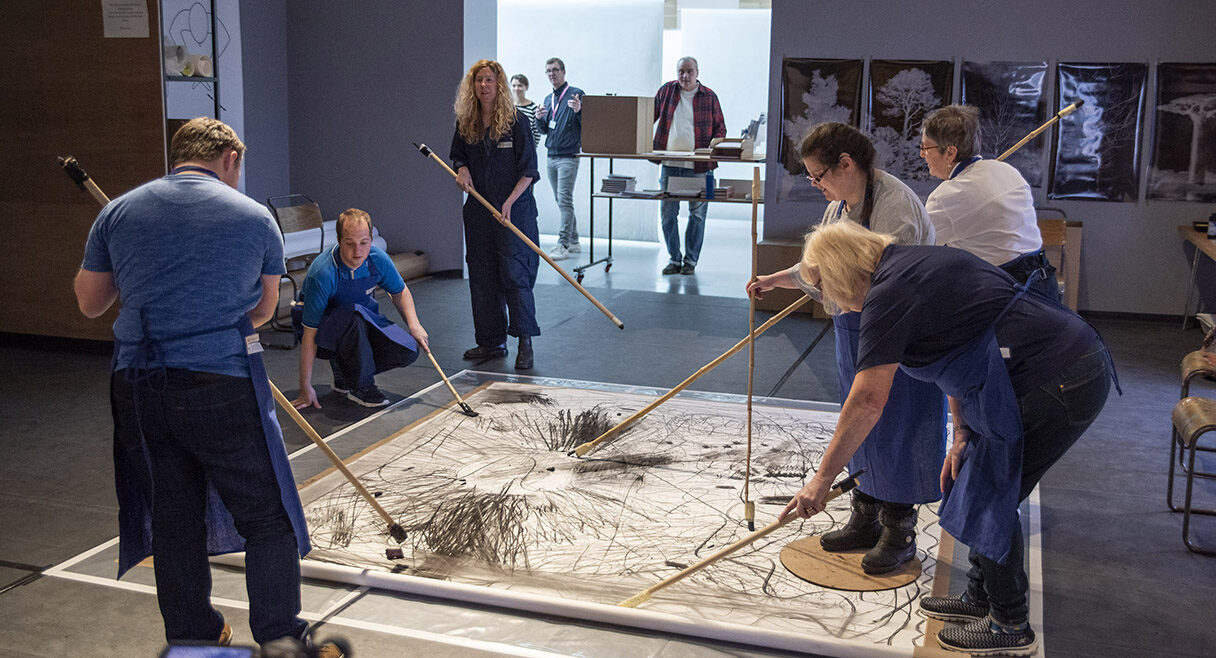
Project Art Works (UK) believe that the arts can drive the creation of radical new models of social care. Working with an expanded concept of art in the tradition of Beuys’ social sculpture, combined with a sensory approach to art and filmmaking, their work challenges perceptions and power relations, creating supportive and deeply affecting interactions between neurotypical and non-neurotypical collaborators.
With Art*People*Care, Project Art Works share the transformative thinking behind their Explorers project and host a Long Table of rotating speakers. Guests include artists Thom and Angelmouse (aka Thom Roberts and Harriet Body) and Sam Kerr (DADAA, Perth) and leading disability and neurodiversity advocate in the arts, Judy Singer, Jeremy Smith (Australia Council for the Arts), alongside Kate Adams, Patricia Finnegan, and Tim Corrigan – Project Artworks.
A podcast of the LIVE event is available here

How the Long Table works
Audience members may watch, listen or join the conversation by taking a seat at the Long Table. Members of the audience are invited to join the guests at the Long Table to have a voice, talk on your own terms, and disrupt or extend the discussion. Paper and drawing materials will be available on the Long Table to allow for non-verbal dialogue / communication.
Free, but bookings essential. Please let us know your access requirements.
Presented by The Big Anxiety, Museum of Contemporary Art Australia and Australia Council for the Arts.
This project has been assisted by the Australian Government through the Australia Council for the Arts, its arts funding and advisory body.
Kate Adams - Project Art Works
Kate Adams is an artist, advocate and parent activist. She has initiated many responsive, collaborative projects with neurodiverse children and adults and their families, care services, artists and galleries.
Kate co-founded Project Art Works in 1997 to explore an expanded conception of art that was and continues to be influenced by Paul Colley, her son, who has complex support needs. The work embraces highly personalised studio practice and exhibitions that raise awareness and influence diverse representation in cultural life. In 2012 Kate was awarded an MBE for services to art and disability.
Jeremy Smith
Jeremy Smith is the Director – Community, Emerging and Experimental Arts at the Australia Council. He has spent much of his professional career working in close
connection with the arts and cultural industries since graduating from the WA Academy of Performing Arts in 1997. Jeremy previously worked at DADAA in WA –
overseeing an extensive regional arts and health programme, in addition to several strategic projects across the organisation. He has also worked extensively across
festivals, youth arts, community and regional arts development projects in a range of creative and management roles.
Thom Roberts and Angelmouse
Thom and Angelmouse is the collaborative art practice of Thom Roberts and Harriet Body. Thom is autistic, and Thom and Angelmouse create work that strives to consolidate their individual views and understandings of the world, both similar and different. They work in installation and video animation and are currently experimenting with collage and new digital print works. Thom is represented by Studio A, a supported studio in Hornsby that supports professional artists with intellectual disability.
Thom Roberts is a north-western Sydney based artist working in painting, performance and installation. Thom’s painting practice is inspired by photographs of people he finds in various information pamphlets and promotional posters that he collects from train stations, shopping centres and other public places. He then draws on top of this image, adding another eye here and an extra nose there, and then uses this as inspiration for large acrylic paintings on canvas.
Harriet Body is a Sydney-based artist, currently working in the expanded field of painting and mark making, with a background in performance and video art. Harriet utilises repetition and endurance, and looks to ideas of the Body Art movement to mark and document time.
Sam Kerr
Sam Kerr is a 26 year old artist and film maker who uses a powered wheelchair for mobility. He lives independently in Fremantle and has worked with DADAA since he was 18 years old. Sam enjoys visual art and began performing as part of the SIGHT UNSEEN Project in 2013. As part of this process, he worked with visual/digital artist, Paul Kaptein to create a filmed component of his live work titled FEY FAY. In 2017 and 2018 Sam worked on another Australia Council funded project, Mixed Reality, and created a work which focused on his identity as a young man living with a disability. SO IT BEGINS has screened as part of THE OTHER FILM FESTIVAL Perth in October 2018 and has been selected for inclusion in THE BIG ANXIETY Festival’s EMPATHY CLINIC in September/October this year.
Judy Singer
Judy Singer is internationally recognized for coining the word “Neurodiversity” in her 1998 Sociology Honours Thesis at UTS. She identified as being in “the middle of three generations of women somewhere on the Autistic Spectrum”. Her work was the first sociological study of the rise of new social movements based on “neurological difference”. In her thesis, she suggested “Neurodiversity” should be added to the intersections of Class, Ethnicity, Gender and Disability, which at that time did not include neurological difference. She has a background in IT, has been active in public housing advocacy. In 2003, Judy co-founded ASteen, Sydney’s only family run social club for AS teens and young adults.